
IP CCTV Systems vs Analogue CCTV: Which Is Better for Your Business in 2025?
- Graham Coughlan
- Nov 13, 2025
- 3 min read
If you're running a business in 2025, you've probably wondered: should I stick with traditional analogue CCTV or switch to IP cameras?
It's a common question as security technology continues to evolve : and the right choice depends on your needs, budget, and plans for the future.
We've broken down the key differences without the tech jargon : just the facts that matter for your business.
What's the Difference?
Analogue CCTV is the traditional setup : cameras connect to a Digital Video Recorder (DVR) via coaxial cables. It's the reliable workhorse that's protected businesses for decades.
IP CCTV, on the other hand, uses digital cameras connected to your data network. Each camera has its own IP address and can transmit footage over your local network or the internet. This unlocks higher resolutions, smart features, and remote access from almost anywhere.

The IP CCTV Advantage
1. Superior Video Quality
Modern IP cameras deliver resolutions up to 4K (8 MP) and beyond, providing exceptional clarity for facial recognition or reading number plates.
By comparison, older analogue systems typically maxed out around 0.5 MP (960H), though modern HD-analogue formats (AHD, HD-TVI, HD-CVI) can now reach 1080p or 2 MP. Still, IP systems remain well ahead in image quality and scalability.
2. Smart, Connected Features
IP cameras now act like mini-computers. They can:
Detect motion and send instant mobile alerts
Recognize faces or license plates (AI analytics)
Count people entering or exiting
Offer two-way audio communication
These advanced functions are usually unavailable or limited in analogue systems.
3. Remote Access from Anywhere
Because IP cameras connect to your network, you can view live or recorded footage securely from your phone, tablet, or laptop : whether you're on-site, travelling, or managing multiple branches.
4. Easier, Scalable Installation
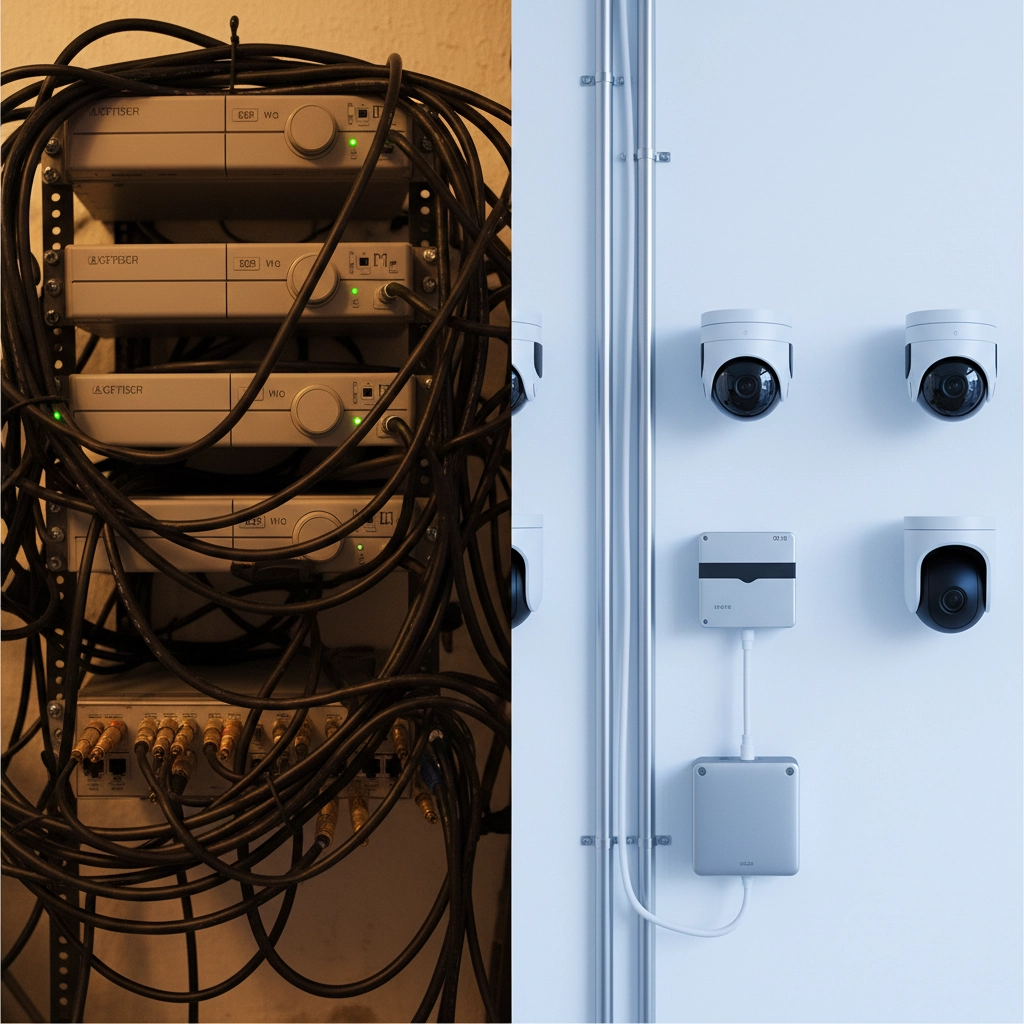
Most IP cameras use Power over Ethernet (PoE) : one cable carries both power and data. This simplifies cabling and can reduce installation time and maintenance, especially when expanding or upgrading your system.
The Analogue CCTV Case
1. Lower Upfront Cost
Analogue systems are cheaper initially. Cameras, DVRs, and cabling cost less, making them appealing for smaller businesses or those on tight budgets.
2. Simple and Reliable Operation
No need for IP addresses or complex network setup : analogue systems are plug-and-play and can operate entirely offline.
3. Compatibility with Existing Equipment
If you already have an analogue setup, you can often reuse existing coaxial cabling and some hardware, avoiding a full system replacement.
Where Analogue Falls Short
Limited Scalability: You're restricted by your DVR's channel capacity. Adding more cameras usually means new hardware and cabling.
Lower Image Quality: Even HD-analogue formats can't match 4K IP clarity.
Fewer Smart Features: Analogue systems generally lack AI, remote management, and advanced analytics.
Security Risks: Analogue video is usually unencrypted, making it potentially more vulnerable to tampering or interception.
The Cost Perspective
While IP cameras typically cost more upfront, several studies and industry analyses suggest they can have lower long-term costs due to:
Fewer cables and simpler expansion (especially with PoE)
Longer device lifespan
Lower maintenance needs
Exact figures vary, but many integrators report that for systems with more than 12–16 cameras, IP often becomes more cost-effective over five years.
Which System Fits Your Business?
Choose IP CCTV if you:
Need high-resolution video for identification
Want smart features and remote monitoring
Plan to expand your system later
Require encrypted, secure transmission
Operate across multiple sites or higher-risk environments
Stick with Analogue if you:
Have a very limited budget
Only need basic recording and playback
Want an offline system without networking
Already have working analogue infrastructure

Our 2025 Recommendation
For most businesses in 2025, IP CCTV is the better long-term investment. Costs have come down, reliability has improved, and smart features deliver genuine operational benefits.
However, analogue still has its place for smaller or low-risk setups that prioritise simplicity and cost over technology.
If you're running analogue today, you don't have to switch everything at once : hybrid systems let you combine IP and analogue cameras for a smooth transition.
The Bottom Line
Security technology continues to advance rapidly, and IP cameras are leading that evolution.
They offer better image quality, smarter functionality, easier scalability, and stronger long-term value for most business environments.
The key is choosing the system that matches your current needs while giving you room to grow. Whether you go with cutting-edge IP technology or stick with proven analogue reliability, the most important thing is having a security system that actually works for your business.
At Hound Security Systems, we've helped hundreds of businesses navigate this decision. If you're still unsure which direction to take, we're always happy to chat about your specific situation and help you find the perfect security solution.
Get in touch today here